Why should you care about DTC?
Author: Andrew Woolston (Intern)
Reviewed by: Ralph DiFiore (CCO), Marcus Magarian, Chris Gioffre
COVID-19 forced our world to find new ways of purchasing goods. As you may have experienced first-hand, consumers leveraged ecommerce platforms to purchase discretionary and staple goods.
Powered by the global pandemic, ecommerce is expected to account for 6.6% of all consumer-packaged good sales. The direct-to-consumer (DTC) movement accounts for 40% of the sales growth in the sector. Additionally, DTC ecommerce customers are expected to hit an all-time high of 103 million by 2022, and numbers are expected to continue to grow as more businesses offer and adopt DTC services. DTC offers brands significant benefits that are expected to enable DTC to thrive in a post-pandemic world.
Why DTC?
DTC retailers lower risk exposed to their supply chain. In a retail environment placement on shelves significantly impact sales and are out of the company’s control. Minor differences in shelf level can cause up to a 25% dip in sales of the product. By adopting a DTC channel, businesses can eliminate typical concerns surrounding retail stores.
DTC improves brands’ bottom line. Eliminating middlemen and supplying products through their own channels allows companies take fewer cuts in their profits and helps improve the company’s margins. As a result, companies can offer their products at lower, more competitive prices than at traditional retailers.
Additionally, DTC allows companies to understand their customers better. The firms can then optimize their business based upon data unrealizable from typical retail channels like big-box retailers. Brands and companies will develop faster and with greater success by utilizing DTC. Enabled by DTC’s ability to understand consumers, Allbirds has made over 35 changes to their original Wool Runner based on concerns and experiences from their customers since its initial launch in 2016. Allbirds now boasts a $1.4 billion private evaluation and generates $100 million in annual revenue.
By focusing on DTC operations, brands have increased their top line and achieved astounding growth. In addition to Allbirds, Bombas (first selling in 2013) brought in over $100 million in sales in 2018 and experienced 40% YoY growth from 2019 to 2020.[1] Chubbies achieved 50% YoY sales growth. Gymshark, which exclusively operates DTC, saw $18.6 million in profit on $176.2 million in sales in 2019. Gymshark currently holds a $1 billion valuation.
DTC’s Necessary Growth
DTC became many consumers’ only option as local stores closed down due to the pandemic. COVID-19 hit brick-and-mortar stores the hardest, forcing businesses to close for many months. As a result, 84% of consumers utilized online retail. 150 million online shoppers claimed it was the first time they have shopped virtually. A staggering 10 years of ecommerce growth occurred in 3 months of the pandemic. Brands are scaling down their retail strategies and focusing efforts on DTC initiatives.
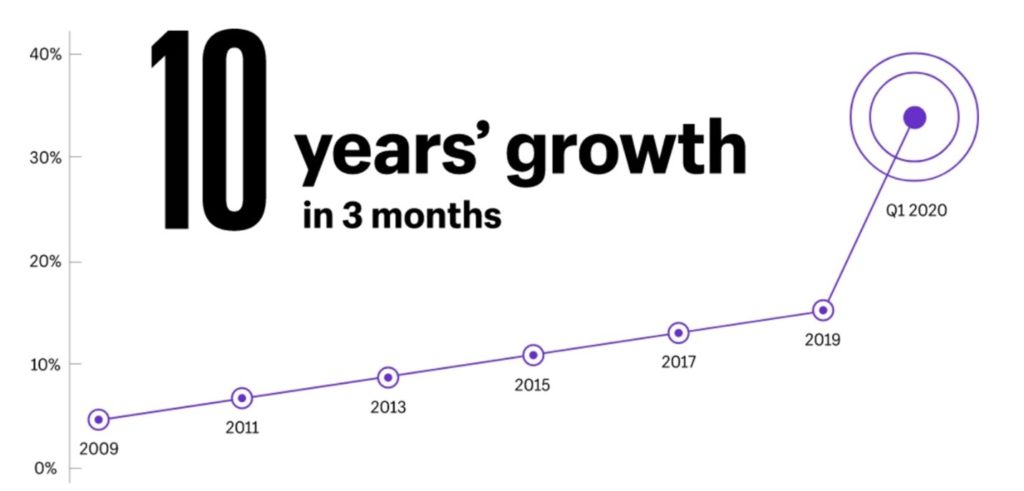
Via McKinsey
VC Involvement in DTC
Investors see the value in improved profit margins with lowered risk and headache from dealing with big-box retailers. Almost 60% of the $3.3 billion invested in consumer-packaged goods involved a DTC component between 2015 and 2019. The inflow of cash to CPG with DTC capabilities has caused big-box retailers to alter their operations. Most notably, Unilever acquired DTC legend Dollar Shave Club for $1 billion in 2016.
DTC Concerns
DTC comes with specific challenges that successful brands manage to overcome. A poor reputation can kill a brand. DTC brands must offer the best possible purchasing experience throughout the process. Everything that may go wrong falls directly on the brand and can significantly impact brand performance. Additionally, Amazon dominates DTC as a marketplace. Brands that rely on DTC must use large amounts of cash for marketing to bypass Amazon’s dominance. 63% of shoppers check Amazon first. To compete, DTC brands increased marketing investment by 30%.
Moving Forward
DTC does not have to be the only option. Nike and Lindt have successfully demonstrated increasing profitability can come from maintaining a big-box retail presence while also utilizing DTC for its specific advantages. Expect continued use of DTC from consumers and more companies to develop a stronger ecommerce presence.
Latest Posts
- Alessandro Bianchi Joins INSILICO as Advisor, Signaling a New Phase for AI-Driven Drug Development
- Alessandro Bianchi Joins Life Biosciences as Strategic Advisor to Support Breakthrough Anti-Aging Therapies
- Alessandro Bianchi, Joins RYLTI as Strategic Advisor to Capital Raise for Disruptive AI Innovation
- Alessandro Bianchi Joins Riddec as Exclusive Advisor to Drive Growth and Capital Raising
- Chatsworth Client ZoomCar Achieves a Public Listing
Archive
- February 2026
- November 2025
- April 2025
- March 2025
- January 2024
- January 2023
- October 2022
- June 2022
- May 2022
- February 2022
- December 2021
- November 2021
- October 2021
- September 2021
- August 2021
- July 2021
- June 2021
Source: (Shopify) DTC-First: Why More Brands are Using the Direct-To-Consumer Model
“The Ultimate Guide to Direct to Consumer Retail (2021) – Shopify.” Shopify Plus, 2021, www.shopify.com/enterprise/direct-to-consumer?utm_source=marketo. Accessed 30 June 2021.
[1] Dishman, Lydia. “How Bombas Grew through Software and Shopper Insights.” Https://Www.uschamber.com/Co, CO- by U.S. Chamber of Commerce, 6 Apr. 2021, www.uschamber.com/co/good-company/launch-pad/bombas-startup-growth. Accessed 30 June 2021.