
Why did the U.S. government restrict access to Anthropic's AI models, and what does it mean for investors and enterprises?
Washington used export controls to suspend two frontier Anthropic models for foreign nationals, signaling that advanced AI is now strategic infrastructure subject to security limits.
The directive named two specific models, Fable 5 and Mythos 5, and was confirmed by Anthropic itself. The legal basis is novel and disputed, and the matter is part of ongoing litigation with the federal government. Anthropic's financials are confirmed: a $47 billion run rate and a $965 billion Series H valuation. The sovereignty reading is one interpretation; a credible counter-read treats the episode as a contested safety action. Enterprises should price AI concentration risk alongside cloud, cybersecurity, and supply chain risk.
Executive Summary
Artificial intelligence has been discussed primarily as a technology story, an investment story, and increasingly as a productivity story. A development in June 2026 involving Anthropic suggests that AI is now entering a fourth phase as a geopolitical story.
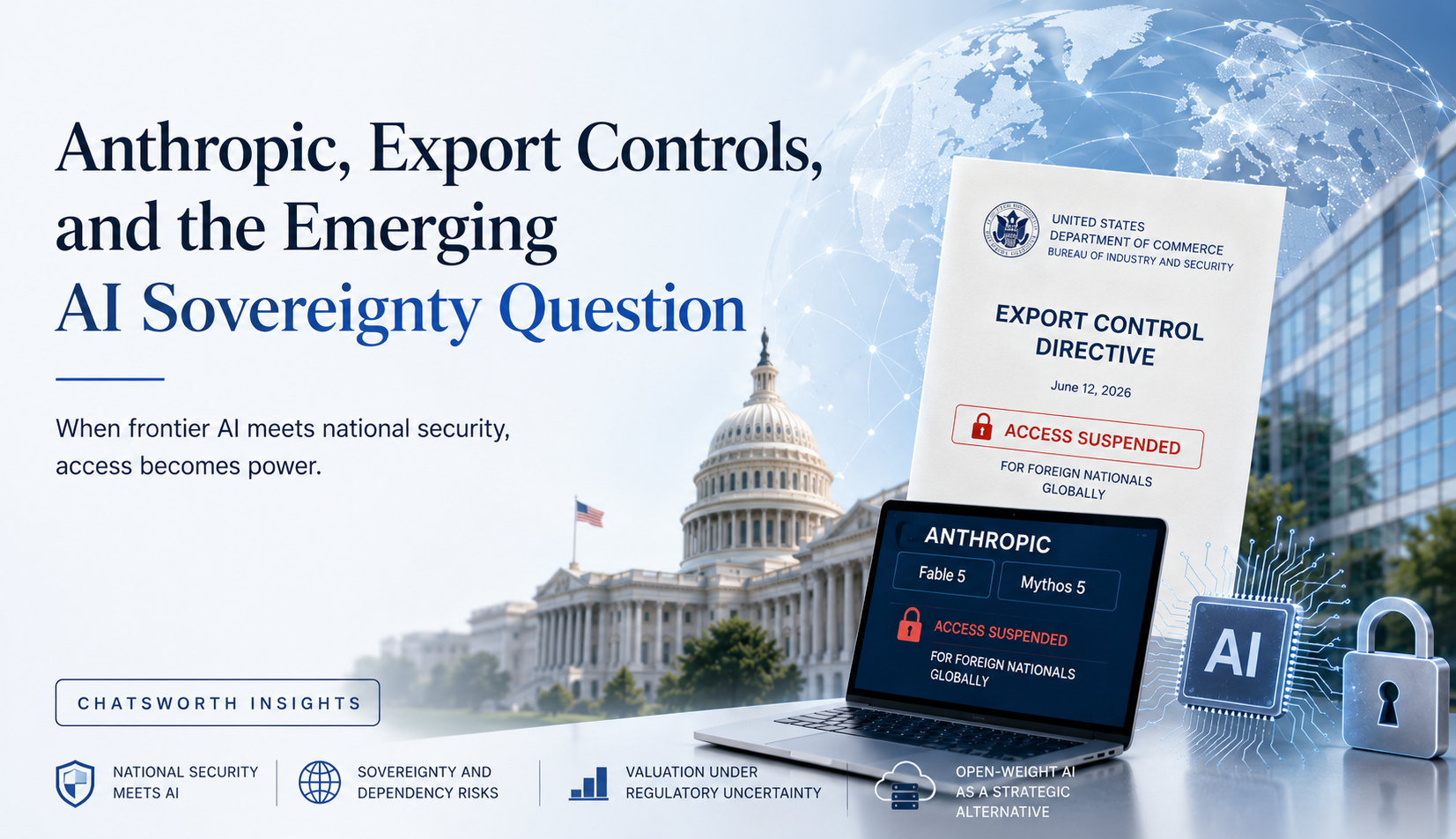
On June 12, 2026, the U.S. Department of Commerce, acting through its Bureau of Industry and Security, ordered Anthropic to suspend access to its two most capable AI models, Fable 5 and Mythos 5, for any foreign national, whether located inside or outside the United States, including Anthropic's own foreign-national employees. Because the company could not reliably screen users by nationality in real time, it disabled both models globally for all customers. Anthropic's other models were not affected.
The action was narrow in scope and total in effect, and that combination is the point. If access to frontier AI systems can be paused through national security mechanisms, enterprises that have embedded those systems into core operations face a category of risk they have not historically priced.
The implications extend well beyond a single company. The episode highlights a growing tension at the center of the AI economy. Model developers are pursuing global adoption and trillion-dollar valuations built on worldwide demand, while governments increasingly treat advanced AI capabilities as strategic assets with national security implications.
For investors, corporate executives, and policymakers, the question is no longer whether AI will reshape the economy. The question is who controls access to the infrastructure that enables that transformation, and under what conditions.
The Rise of Anthropic
Anthropic was founded in 2021 by former OpenAI researchers and executives who set out to build advanced AI systems with a stronger emphasis on safety and alignment.
The company became widely known through its Claude family of large language models and its coding platform, Claude Code. Unlike competitors that prioritized rapid consumer adoption, Anthropic built its reputation around responsible AI development and governance.
That approach attracted substantial capital. In its Series H round, announced on May 28, 2026, Anthropic raised $65 billion at a $965 billion post-money valuation, nearly tripling its February valuation of $380 billion. The company reported that its run-rate revenue crossed $47 billion earlier that month, and it has since filed confidentially for a public listing.
If those figures hold, they place Anthropic among the most valuable private technology companies in history. More importantly, they reflect the expectations investors currently hold for the future economics of artificial intelligence. The underlying assumption is straightforward. AI will become a foundational layer of the global economy, and a small number of model providers will capture a disproportionate share of the resulting value.
The events of June 2026 test that assumption.
When AI Meets Export Controls
For decades, export controls have applied to technologies deemed strategically important to national security, including advanced semiconductors, aerospace systems, encryption technologies, military hardware, and nuclear technologies.
Frontier artificial intelligence is now entering that category. What distinguishes the Anthropic directive is the instrument used. Prior controls in the AI supply chain targeted physical inputs such as chips and cloud infrastructure. The June 12 directive targeted access to the model itself.
The legal basis is novel and contested. Reporting and analysis indicate the directive relied on the authority in the Export Control Reform Act to establish interim controls on emerging and foundational technologies by informing a party that a license is required. That authority had not previously been used in this way, and there is no established regulatory framework implementing it. Analysts have questioned whether a foreign national accessing a cloud-hosted model on a U.S. provider's servers constitutes an export of software or technology at all, since no model weights leave the provider. These are unresolved legal questions, not settled doctrine.
For many businesses, the directive forced consideration of a possibility that previously seemed theoretical. Historically, software companies could assume that once a product was built, it could be distributed globally with limited restrictions. Frontier AI may prove different. As governments come to view advanced AI capabilities as technologies with potential military, intelligence, cybersecurity, and strategic implications, AI providers may face obligations that resemble those applied to strategic industries rather than conventional software companies.
The Contested Rationale
The reasons behind the directive are disputed, and the disagreement is material to how the episode should be read.
The government cited national security concerns and, according to multiple accounts, acted after warnings that a method existed to bypass Fable 5's safeguards and use the model to identify software vulnerabilities. Some reporting further suggested concern that a China-linked group had accessed the underlying Mythos technology, though that account is single-sourced and disputed.
Anthropic pushed back publicly. The company characterized the concern as a narrow, non-universal technique rather than a broad defeat of the model's guardrails, and argued that comparable capability is already available from other deployed models. At least one security researcher familiar with the underlying work has described it as defensive research rather than a jailbreak.
The directive also lands inside an active and escalating conflict. Since early 2026, Anthropic and the federal government have been in dispute over the military's use of Claude, after the company declined to permit its products to be used for mass domestic surveillance or for autonomous weapons systems without human oversight. The Pentagon designated Anthropic a supply chain risk, a label historically reserved for foreign adversaries, and the administration directed federal agencies to stop using the company's products. Anthropic sued, and a federal court granted a preliminary injunction on the use ban while litigation continues. The export-control directive must be read against that backdrop rather than as an isolated act.
None of this is dispositive. The administration may have responded to a genuine and serious concern, or it may have acted disproportionately, or the action may be closer to the running feud than to any specific danger. The relevant point for enterprises and investors is narrower. The capability now exists, and has been used, to pause access to a frontier model through national security authority.
The Sovereignty Question
The reaction in Europe was immediate. Within hours, European policymakers and commentators framed the episode as a demonstration of the dependency risks they had warned about for years in cloud infrastructure, semiconductors, and digital platforms.
That framing deserves scrutiny rather than reflexive endorsement. A reasonable counterargument holds that this was not an anti-European action at all. The government's apparent aim, if the reporting is accurate, was to have the models paused on cybersecurity grounds for all users, Americans included. The reach to foreign nationals appears to have been an artifact of export-control law being the only instrument immediately available, not a deliberate effort to carve out Europe or any allied country. On that reading, the episode is a contested safety intervention executed through an imperfect legal tool, not a sovereignty kill switch.
Both readings can be held at once, and the practical conclusion is the same. A European enterprise may invest heavily integrating an AI platform into software development, cybersecurity operations, customer service, legal review, research, and financial analysis. If access to that platform can become subject to a foreign government's decision, for whatever reason, the dependency itself is a strategic risk that must be managed. This is not a criticism of any particular government. The same concern would exist if a European, Chinese, or any other authority exercised similar control over a technology relied upon globally.
As AI becomes embedded in mission-critical workflows, enterprises should begin evaluating AI concentration risk in the same way they evaluate cloud concentration risk, cybersecurity risk, and supply chain risk.
The Investment Implications
The valuation question may matter more than the regulatory one.
The current generation of frontier AI companies commands extraordinary valuations because investors expect AI markets to exhibit winner-take-all dynamics. The precedent is not unreasonable. Search, social media, and mobile operating systems all became highly concentrated. Investors assume AI will follow a similar path.
That assumption depends on several conditions holding. Providers must be able to distribute their products globally. Switching costs must become substantial. Competitors must struggle to replicate capabilities. Margins must remain durable.
The emergence of export controls introduces uncertainty into the first condition. The rapid advance of open-weight models introduces uncertainty into the second and third. Together, these developments could meaningfully alter the economics of the industry, and they argue for distinguishing carefully between AI adoption, which appears broad and durable, and AI monetization at the model layer, which is less certain than current valuations imply.
The Open-Weight Challenge
One consequence of the episode may be an acceleration of open-weight AI adoption.
Unlike proprietary, cloud-hosted systems, open-weight models can often be deployed directly on enterprise infrastructure. That creates several advantages, including greater operational control, reduced vendor dependency, enhanced data privacy, lower long-term cost, and reduced geopolitical exposure. Organizations that host models internally are generally less vulnerable to disruptions arising from commercial disputes, policy changes, or regulatory actions affecting third-party providers.
This does not mean open-weight models will displace frontier providers. It suggests that enterprises may increasingly pursue hybrid strategies that balance performance, cost, security, and sovereignty considerations. Such a shift would reduce the likelihood that a small number of providers capture all of the economic value generated by artificial intelligence.
Why Governments Are Paying Attention
The government's perspective is also understandable. Advanced models are increasingly capable of writing software, identifying vulnerabilities, automating research, analyzing large data sets, supporting scientific discovery, and accelerating engineering workflows. Those capabilities create enormous economic opportunity. They also create potential national security concerns, particularly where the same capability that helps defenders find flaws could assist offensive cyber operations.
Governments have historically sought to regulate transformative technologies when they believed strategic advantage was at stake. Artificial intelligence is unlikely to be an exception. The challenge is balance. Excessive restriction could slow development and reduce competitiveness, while insufficient safeguards could create risks policymakers find unacceptable. The directive at issue applies only to one company, but the uncertainty over the scope of the underlying authority raises questions for the entire industry, because every provider must now consider the possibility that similar controls could be used again. Finding the appropriate balance may become one of the defining policy questions of the coming decade.
What This Means for Corporate Leaders
For boards, executives, and investors, several practical lessons emerge.
First, AI should increasingly be treated as infrastructure rather than as ordinary software. Organizations should assess how dependent critical business functions have become on specific providers.
Second, enterprises should evaluate contingency plans and alternative providers. Vendor diversification is becoming an element of AI governance.
Third, management teams should weigh sovereignty and regulatory exposure alongside traditional selection criteria. Cost and performance remain important, but resilience and control are becoming more relevant.
Fourth, investors should separate AI adoption from AI monetization. There is little doubt that AI will generate significant productivity gains. The harder question is whether those gains accrue primarily to model developers or to the businesses that deploy the technology. Those are not necessarily the same outcome.
The Future of AI May Look Different Than Expected
The dominant narrative has assumed that a handful of companies would build increasingly powerful models and capture enormous economic rents from the rest of the economy. Recent events suggest a more complicated path. National security considerations, geopolitical competition, open-weight innovation, regulatory intervention, and enterprise risk management are all beginning to shape the trajectory of the market.
Artificial intelligence remains one of the most transformative technologies of our era. The long-term winners, however, may not simply be the companies building the largest models. They may be the participants who successfully navigate the intersection of technology, economics, regulation, and geopolitical reality.
The Bottom Line
The significance of the Anthropic episode extends beyond one company, one model, or one regulatory action. It marks a broader shift. Artificial intelligence is evolving from a software product into strategic infrastructure, and as that transformation continues, questions of sovereignty, access, control, and resilience will become more important.
For investors, executives, and policymakers, the lesson is straightforward. The future of AI will not be determined solely by technical performance. It will also be determined by who controls access to the technology, under what conditions, and how the global economy chooses to govern one of the most powerful innovations ever created.
This article is based on publicly available reporting and on Anthropic's own public statements as of June 2026. Certain developments, including the legal basis for and scope of the June 12, 2026, directive, remain subject to ongoing litigation and regulatory clarification. Chatsworth Securities LLC has not independently verified all third-party reporting referenced herein. This material is provided for informational purposes only and does not constitute investment, legal, tax, or regulatory advice, nor a recommendation with respect to any security.
On June 12, 2026, the U.S. Commerce Department ordered Anthropic to suspend access to its Fable 5 and Mythos 5 models for any foreign national, and the company disabled both models globally because it could not screen users by nationality. The directive was narrow, since other Anthropic models stayed live, but its effect was total for the two models named. The legal basis is novel and contested, and the action sits inside active litigation between Anthropic and the federal government. For investors and enterprises, the episode marks the point at which frontier AI became strategic infrastructure subject to national security controls.
When to speak with Chatsworth
You may benefit from an advisory conversation if your board is evaluating timing, valuation expectations, buyer universe quality, or diligence readiness. Chatsworth provides senior-led perspective on process design and execution risk independently of whether a mandate results.
Speak with the team →This article is published by Chatsworth Securities LLC (CRD #40804) for informational purposes only and does not constitute legal, tax, or securities advice. See our Terms of Use.
Marcus Magarian, Managing Director. M&A advisory, strategic advisory, cross-border transactions, and technology-sector advisory. chatsworthgroup.com/our-team/marcus-magarian
LinkedIn Profile →Strategic perspectives on M&A, capital formation, and cross-border transactions, delivered directly.
Subscribe